Aunt March
Little WomenAunt March is the irascible, wealthy, childless relative whose practical needs bring Jo into her household and whose death ultimately gives Jo Plumfield. She stands at the intersection of money, family obligation, and female independence: her fortune can tempt the March family, her temper imposes daily discipline, and her neglected library offers Jo a refuge in which ambition and imagination can grow. Although she often appears as a comic domestic tyrant, her connection with Jo becomes one of the novel's most consequential relationships.
Family, Wealth, and Principle
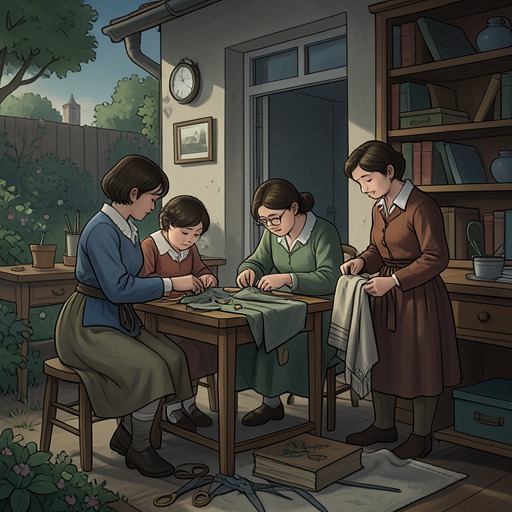
Aunt March becomes important to the March family when poverty follows their troubles. She had offered to adopt one of the girls, and she was offended when the offer was declined. Friends warned the Marches that refusing her would cost them any hope of being remembered in her will, but the family refused to exchange its unity for financial security. Their position was expressed in the principle, "We can't give up our girls for a dozen fortunes. Rich or poor, we will keep together and be happy in one another." Aunt March therefore begins as a test of whether economic dependence can override family loyalty; the Marches answer by treating their daughters as people who cannot be surrendered for an inheritance.
Her wealth is nevertheless a continuing force in the girls' lives. The possibility of her favor, and the fear of losing it, reveal how closely marriage, employment, inheritance, and domestic security are tied to class. Aunt March is not merely an unpleasant older relation but a person whose resources give her authority over younger women. The family's refusal to submit to that authority preserves its moral independence, while Jo's later employment shows that affection and resistance can coexist with the need to earn a living.
Jo as Companion and Employee
After a period of anger, Aunt March meets Jo at a friend's house and is attracted by the girl's comical face and blunt manners. She proposes taking Jo as a companion. Jo does not like the position, but accepts it because no better opportunity is available. The arrangement unexpectedly succeeds: the two have occasional tempests, and once Jo marches home declaring that she cannot endure the situation any longer, yet Aunt March quickly relents and urgently sends for her return. Jo cannot refuse, partly because she has come to like the peppery old lady beneath the irritability.
The relationship is thus built through friction rather than easy tenderness. Aunt March requires service and obedience, while Jo brings independence, impatience, and a refusal to make herself conventionally docile. Their repeated quarrels do not end the connection; instead, each reconciliation establishes that the household contains a durable attachment beneath its noise. Aunt March's response to Jo also suggests that the very qualities which make Jo unsuitable for a passive role—her directness, energy, and unusual manner—can make her valuable company.
The Library and Jo's Education
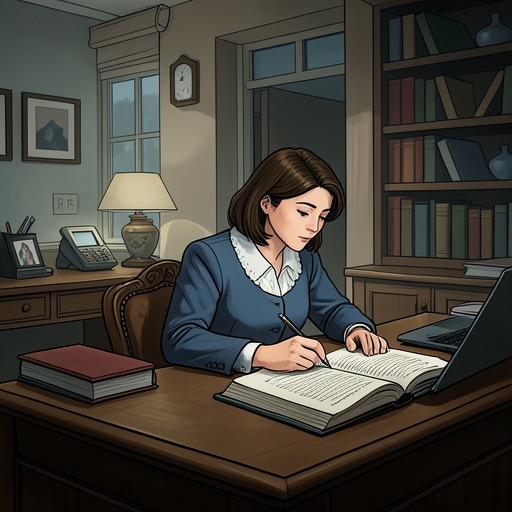
Aunt March's house contains the most powerful attraction for Jo: a large library of fine books left to dust and spiders after Uncle March's death. Jo remembers the kind old gentleman who let her build railroads and bridges with his large dictionaries, told her stories about strange pictures in his Latin books, and bought her gingerbread cards in the street. The library preserves that earlier affection, but it also gives Jo an intellectual space unavailable in the ordinary routines of domestic service.
Jo slips into the room whenever Aunt March naps or entertains visitors, curling into an easy chair to devour poetry, romance, history, travel, and pictures. The room's bookshelves, busts, globes, cabinets, and chairs make it a region of bliss for a girl who is already described as a bookworm. Yet the refuge is never wholly hers: a shrill call for “Josy-phine! Josy-phine!” can summon her away to wind yarn, wash the poodle, or read Belsham's Essays. The contrast is decisive. Aunt March's demands interrupt Jo's reading, but the employment also places Jo beside the library that enlarges her mind. Domestic labor and literary aspiration are not separated; Jo's emerging independence is forged within the very arrangement that constrains her.
Encounters with the March Household
Aunt March remains an active presence in the family's social order even when Jo is not at her house. When Beth contracts scarlet fever, Dr. Bangs orders Amy away from home, and Aunt March receives Amy, Jo, and Laurie with her customary hospitality. Her sharp manner appears immediately in her question about what they want and in the parrot's cry, "Go away. No boys allowed here." The scene preserves her comic severity while showing that her house can function as a place of shelter during a family emergency.
She also belongs to the older generation whose expectations surround the sisters' futures. When Jo fears that Meg's attachment to John Brooke will divide the family, she hopes that her mother will reject him and suggests sending him away. The family does not treat Aunt March's wealth as a reason to pursue a richer match, however. The March household's broader ethic is that marriage should not be organized around money, and Aunt March's presence makes that ethic materially intelligible: wealth is available as a social power, but the sisters' lives are not to be arranged simply to secure it.
Death, Inheritance, and Transformation
Aunt March dies suddenly during the second year of Jo's long courtship with Professor Bhaer. The family mourns her despite her sharp tongue, an acknowledgment that difficult affection is still affection. Her death then produces an unexpected reversal: she leaves Plumfield to Jo. What had been a relationship structured by service and command becomes the source of Jo's economic and spatial independence.
Jo refuses Laurie’s assumption that she will sell the estate for the handsome sum it could bring. Instead, Plumfield makes possible a life organized around education and care. Jo marries and settles there, and a family of six or seven boys soon grows around the Bhaers. Mr. Laurence repeatedly brings them cases of destitute boys and offers to pay something toward their support, helping populate the household with the poor as well as the rich. The once prim and orderly property becomes a boys' paradise, filled with unruly energy and open play. In this transformation, Aunt March's inheritance is redirected from private possession into a communal educational home.
Narrative Function and Significance
Aunt March is both a comic figure and a structural agent. Her lame body and dependence on an active companion make her need for Jo concrete, while her wealth exposes the economic pressures surrounding a poor family. Her temper creates recurring domestic conflict, but her attraction to Jo's unconventional personality prevents her from becoming a wholly one-dimensional obstacle. She can be demanding, offended, hospitable, and attached; the novel's treatment of her allows irritation and love to remain present at the same time.
Her final importance lies in the difference between what her fortune could have represented and what Jo makes it become. The family once refuses to surrender a daughter for “a dozen fortunes”; later, Aunt March's actual fortune enables Jo to build a family that includes children who lack security. Plumfield therefore completes a moral reversal. Money that first threatens to divide the Marches is eventually absorbed into their ethic of loyalty, labor, education, and care, while Aunt March's neglected domestic world is transformed into the living school Jo has always needed room to create.